
🔑 Key Takeaways
Formulating a supplement idea into an actual product takes more than a great formula — you need the correct manufacturer. If you're starting your own wellness brand or expanding an existing healthcare product, finding a dependable private label or third-party supplement manufacturer can be the difference between success and failure. When you are starting your supplements brand, the first decision you need to make is whether you want a custom formulation or a private label. The decisions you make will affect not just your start-up expenses and time to market but also your product differentiation—and profit margins too. In this blog, we will try to find out the pros and cons from the perspective of both private label and third-party supplement formulation options.
The global dietary supplements market was valued at USD 192.65 billion in 2024 and is projected to reach USD 414.52 billion by the end of 2033, growing at a CAGR of 8.9% over a forecast period (2018-2033). Potentially growing that way, your manufacturing strategy to increase market share can greatly impact it.
However, wherever you fall in the private label vs. third-party supplements decision tree, that should be matched to your overall brand strategy, capabilities, and stance within the competitive landscape.
The most optimal is the one that provides a solid base for the particular supplement business you're developing.
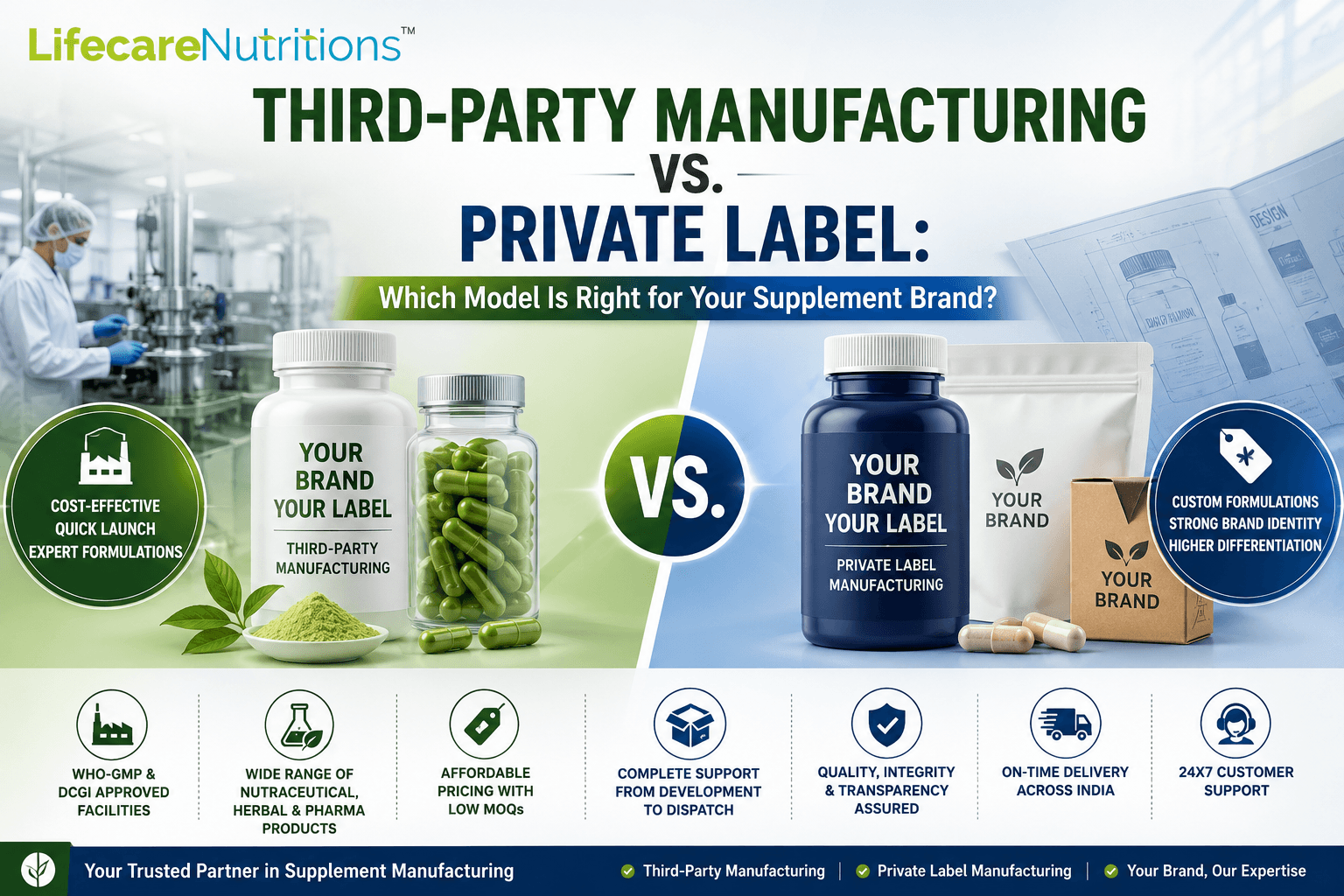
Let's start simple: the manufacturer makes your product; you sell it using your brand name. The final product is developed by the manufacturer and marketed under the client's company name based on the product information provided by the client company or product formulations provided by the manufacturer.
Here are some of the major characteristics of third-party manufacturing:
One such instance is if any pharma distributor desires to introduce a customized catalog of their table manufacturing or a supplement, then they will reach out to Lifecare Nutritions, which offers third-party manufacturing services. Once you give them an order, you will get the products finished with a brand of your company's name.
Again, here we begin with simple words when choosing the product specification, packaging style, ingredients, and sometimes even the formula when you make your decision. It is a better option than third-party manufacturing since the products are capable of being modified to suit the brand's requirements. Products marketed by the brand are its own creation, development, and manufacturing
Private label manufacturing includes a number of key features, such as
It can be developed by Lifecare Nutrition by private-label manufacturing.
This will vary by business. Your business goals are like the following:
By selecting third-party manufacturing, you will receive:
By selecting private label manufacturing, you will receive:
Some of the reasons why you should opt for Lifecare Nutrition for your business are:
Are there any custom formulations developed by Lifecare Nutrition?
Of course, they offer private label manufacturing for nutraceuticals, herbals, and pharma products.
For start-ups, what manufacturer is ideal?
Third-party manufacturing is ideal for startups due to low investment, speedy product availability, and reduced formulation development.
What is the quicker business return, using which model?
To get the products to market quickly, consider third-party manufacturing for the low cost of manufacturing.
Which model provides a better brand differentiation?
There is also greater differentiation for the brand, as third-party manufacturing enables the product to have a unique formulation, according to the brand's positioning.
Are both manufacturing models supported by Lifecare Nutrition?
Yes, it offers WHO-GMP-certified third-party and private-label manufacturing. This is beneficial as it offers formulation help, regulatory assistance, and scalability, as well as branding help.
Is there a future for outsourced pharma manufacturing in India?
Pharmaceutical manufacturing is a growth model with a CAGR of 10% in the given scenario with a strong home market, improving exports, and support by the government.
Which one will offer higher profit margins?
The long-term margin benefits are high in third-party manufacturing, while private-label manufacturing has a moderate margin.
How long will it take to transition from a private brand to 3rd party production?
The process can take 30-90 days depending on the formulation development, approvals, and package changes.